
All My Heroes Are Dead Except for La Borinqueña: Care, Reverie, and the Reinvention of the Heroine
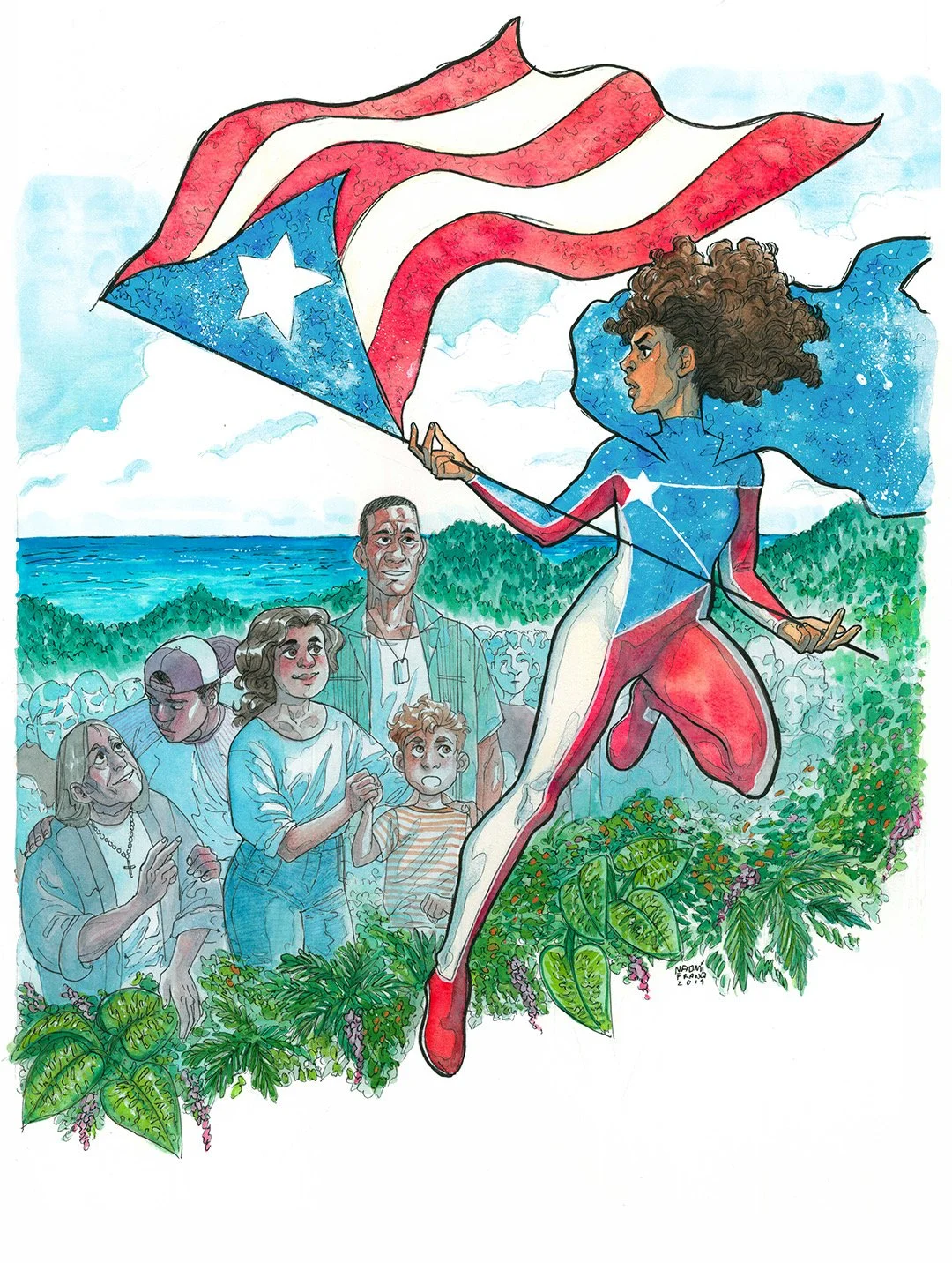
Illustration made by Noemi Franq and provided by the author of “La Borinqueña” Edgardo Miranda-Rodriguez.
La Borinqueña emerges within a cultural moment increasingly skeptical of the traditional hero: the solitary savior whose power depends upon conquest, domination, and spectacle. In contemporary visual culture, the superhero has become both omnipresent and exhausted. The figure once imagined as a symbol of justice and transcendence now frequently appears trapped within repetitive narratives of violence, imperial fantasy, and hyper-individualism. The contemporary public no longer encounters the superhero as an impossible aspiration, but rather as an overproduced mythology embedded within corporate entertainment systems. Against this landscape of symbolic fatigue, La Borinqueña, the Puerto Rican superhero created by Edgardo Miranda-Rodriguez, emerges not merely as another masked figure within comic book culture, but as an alternative model of heroism grounded in collective memory, poetic imagination, ecological consciousness, and care.
Unlike the dominant traditions of American superhero narratives, which often privilege exceptionalism and militarized power, La Borinqueña constructs heroism through relationships. The heroine’s identity is inseparable from Puerto Rican history, diasporic experience, environmental vulnerability, and communal resilience. Her powers do not isolate her from ordinary life; rather, they deepen her connection to the island, its people, and its cultural memory. In this sense, La Borinqueña participates in a larger cultural reconfiguration of what heroism might mean in the twenty-first century. The comic reframes strength not as domination over others, but as the capacity to preserve, remember, and care for vulnerable communities living under the persistent conditions of colonial precarity.
The history of the superhero itself feels strangely proximate. Wonder Woman, one of the earliest and most culturally influential female superheroes in American popular culture, was partially conceived in nearby Rye, New York, where psychologist William Moulton Marston—writing under the pen name Charles Moulton—lived during the 1940s with his wife Elizabeth Holloway Marston and their partner Olive Byrne. Marston famously envisioned Wonder Woman as an alternative to the violent masculinity dominating early superhero narratives, imagining instead a heroine grounded in truth, emotional intelligence, and feminine authority. Yet despite these radical intentions, Wonder Woman remained embedded within broader American mythologies of exceptionalism and national identity. Decades later, La Borinqueña extends and complicates this lineage by constructing a heroine whose power emerges not from imperial universality, but from the specific historical, ecological, and colonial realities of Puerto Rico.
Through the theoretical lenses of María Tatar’s The Heroine with 1001 Faces, Gaston Bachelard’s philosophy of reverie, Boris Groys’ writings on care, and Umberto Eco’s understanding of symbolic systems (semiotics), La Borinqueña can be understood as a decolonial reinvention of the superhero narrative. Rather than reproducing the traditional mythology of conquest associated with many heroic archetypes, the comic proposes a heroine whose power emerges through imagination, emotional intelligence, and collective responsibility. In doing so, La Borinqueña not only challenges dominant forms of superhero representation but also suggests that contemporary heroism may survive only through new ethical and poetic relations to the world.
The traditional superhero has historically operated through a logic of exceptionalism. From Superman’s alien superiority to Batman’s technological mastery and the militarized structures of many contemporary cinematic universes, heroism within mainstream American comics has often been linked to conquest, control, and spectacle. Even when framed as benevolent, these figures typically embody fantasies of domination. Their narratives depend upon crises resolved through force, surveillance, or sacrificial violence. María Tatar’s The Heroine with 1001 Faces offers a crucial framework for reconsidering these structures. Tatar critiques the masculine linearity embedded within classical heroic narratives and proposes alternative forms of heroism grounded in transformation, intuition, relational intelligence, and survival.
For Tatar, the heroine’s journey frequently resists the triumphalist structures associated with patriarchal myths. Instead of conquering the external world, the heroine navigates instability, emotional complexity, and communal interdependence. Strength emerges not through invulnerability but through adaptability. This distinction becomes particularly important when examining La Borinqueña. Unlike the detached superhero whose identity separates them from ordinary people, La Borinqueña’s power is inseparable from the social body of Puerto Rico itself. Her heroism is fundamentally collective.
The visual language of the comic reinforces this difference. Rather than centering endless spectacles of destruction, the narrative repeatedly emphasizes landscapes, neighborhoods, conversations, and acts of mutual aid. The heroine does not function as an authoritarian savior descending upon helpless subjects; instead, she operates as part of a living community shaped by memory, environmental struggle, and cultural resilience. Her identity is inseparable from Puerto Rican history and from the island’s relationship to colonialism, migration, and ecological vulnerability.
This distinction is politically significant. Traditional superhero mythology often reproduces imperial fantasies in which extraordinary individuals preserve social order through violence. In contrast, La Borinqueña reframes power through reciprocity. The heroine’s relationship to the island is not extractive but intimate. Her powers are activated through connection rather than separation. In this sense, the comic destabilizes the individualism that dominates much of Western heroic mythology.
Tatar’s work also allows for a reconsideration of vulnerability within heroic narratives. Mainstream superheroes frequently attempt to transcend vulnerability through technological enhancement, divine strength, or emotional detachment. Yet La Borinqueña embraces fragility as a condition of ethical relation. The heroine remains emotionally and culturally embedded within the realities she seeks to protect. Her humanity is not a weakness that interrupts heroism; it is the very condition that makes heroism possible. Through this framework, the comic proposes an ethics of relational survival rather than conquest. If Tatar helps illuminate the transformation of heroic structures within La Borinqueña, Gaston Bachelard’s philosophy On Poetic Imagination and Reverie reveals the emotional and symbolic architecture of the comic’s world. Bachelard argues that imagination is not simply decorative fantasy but a fundamental mode of inhabiting reality. Reverie allows human beings to construct intimate relationships with space, memory, and matter. Through poetic imagination, landscapes become emotional territories charged with psychic significance.
Within La Borinqueña, Puerto Rico functions not merely as a geographic setting but as a poetic landscape shaped by memory, longing, and historical trauma. Oceans, storms, forests, and skies operate symbolically throughout the narrative, transforming the island into what Bachelard might describe as an oneiric space—a landscape inhabited simultaneously by material and emotional realities. The island becomes both homeland and dreamscape, a place continuously reconstructed through imagination. This poetic dimension becomes especially important when considering the historical context surrounding Puerto Rico’s environmental and political crises. In the aftermath of Hurricane Maria, the island became internationally visible through images of devastation, infrastructural collapse, and governmental neglect. Yet, La Borinqueña refuses to reduce Puerto Rico to catastrophe alone. Instead, the comic reconstructs the island through reverie and symbolic vitality. Nature does not appear merely as a destructive force but as a source of ancestral continuity and cultural power.
Bachelard writes extensively about the emotional resonance of elemental imagery, particularly water, air, and storms. These elements recur powerfully within La Borinqueña. Storms become more than meteorological phenomena; they function as symbolic manifestations of historical instability and colonial violence. Simultaneously, they also evoke transformation and renewal. Water operates as memory itself: fluid, diasporic, unstable, yet continuous.
The comic’s visual atmosphere frequently privileges moments of contemplation rather than pure action. Landscapes linger. Colors soften...
…Architectural spaces acquire emotional depth. These aesthetic choices create an experience within the reader. Puerto Rico is imagined not through the detached gaze of tourism or spectacle, but through social intimacy. In this sense, the comic resists colonial modes of representation that reduce the island to exotic scenery or economic territory. Instead, it restores emotional subjectivity to the landscape. Bachelard’s philosophy also helps explain why imagination itself becomes political. Colonial systems frequently seek to control not only territory but also symbolic possibility. To imagine differently, here the Heroine allows us to become a form of resistance. La Borinqueña participates in this resistance by constructing new symbolic relationships between identity, memory, and futurity. The heroine embodies not simply political survival, but imaginative survival. She carries the possibility that another symbolic world remains conceivable.
This movement toward preservation and imaginative continuity connects deeply with Boris Groys’ Philosophy of Care. Groys argues that care constitutes a fundamental cultural and ethical activity. Modern societies often celebrate innovation, productivity, and spectacle while invisibilizing the labor required to preserve life, institutions, and collective memory. Care work—maintenance, protection, restoration—frequently remains culturally undervalued precisely because it resists spectacular visibility. Yet without care, social worlds collapse. La Borinqueña radically reframes heroism through this ethics of care. The heroine’s primary function is not conquest but preservation. She protects communities, ecosystems, histories, and relationships endangered by neglect and structural violence. This distinction transforms the meaning of power within the comic. Heroism no longer depends upon domination over enemies or systematic coercion, but upon sustained attention to vulnerable forms of life.
This framework becomes especially resonant within the political realities of Puerto Rico. The island’s relationship to the United States has long been shaped by economic extraction, political dependency, and infrastructural precarity. Following environmental disasters such as Hurricane Maria, many Puerto Rican communities survived not because of institutional intervention, but because of collective networks of mutual aid and communal care. Within this context, La Borinqueña emerges as a symbolic extension of these practices.
The comic repeatedly foregrounds collective survival rather than individual glory. Community kitchens, neighborhood solidarity, environmental stewardship, and cultural continuity become forms of heroic action. This emphasis challenges dominant superhero narratives that equate heroism with militarized intervention. Instead, La Borinqueña proposes that the labor of maintaining life may itself constitute the most radical form of power. Groys’ philosophy is particularly useful because it shifts attention away from spectacle and toward duration. Care is repetitive. It requires ongoing commitment rather than a singular triumph. This temporality differs profoundly from traditional superhero narratives structured around climactic battles and final victories. In La Borinqueña, heroism is continuous and unfinished. The heroine’s work cannot permanently eliminate vulnerability because vulnerability is part of collective existence itself. Instead, heroism consists in remaining present despite fragility.
This understanding of care also intersects with feminist critiques of labor and visibility. Historically, forms of maintenance and emotional labor associated with women and marginalized communities have been culturally devalued because they do not produce spectacular visibility. By centering care within a superhero narrative, La Borinqueña destabilizes patriarchal assumptions about power itself. Protection becomes more important than conquest. Healing becomes more transformative than destruction. At the same time, the comic avoids reducing care to passive sentimentality. Care within La Borinqueña remains political. To preserve communities under colonial conditions requires resistance. To maintain cultural memory within systems of erasure requires active symbolic labor. Thus, the heroine’s care becomes inseparable from decolonial struggle. She does not simply comfort the vulnerable; she participates in the reconstruction of collective dignity.
This reconstruction operates largely through symbolism, mythology, and narrative systems, which brings Umberto Eco into the conversation. Eco’s work, particularly Foucault’s Pendulum, examines the human tendency to construct meaning through interconnected signs and symbolic structures. Modern societies continuously generate myths that organize collective identity and historical understanding. Superheroes themselves function as contemporary mythological figures: symbolic narratives through which societies imagine morality, power, and belonging. La Borinqueña consciously intervenes within this mythological field. The comic constructs a symbolic counter-narrative to the dominant mythology of American superhero culture. Puerto Rican identity, often marginalized or invisibilized within mainstream media, becomes central rather than peripheral. The heroine’s visual iconography—including references to the Puerto Rican flag, indigenous histories, folkloric imagery, and diasporic symbolism—creates an alternative symbolic architecture through which collective identity can be imagined.
Eco’s perspectives help illuminate how these symbols operate culturally. Symbols do not possess fixed meanings; rather, they generate networks of association continuously interpreted and reinterpreted by communities. La Borinqueña participates in this dynamic process by transforming Puerto Rican cultural references into active mythological material. The comic does not merely represent Puerto Rican identity; it mythologizes it. This mythmaking is especially important within colonial contexts where symbolic representation becomes politically contested. Colonial systems frequently control cultural narratives by determining whose histories appear visible, heroic, or universal. By inserting a Puerto Rican heroine into the superhero canon, La Borinqueña disrupts these hierarchies of visibility. The comic insists that Puerto Rican stories belong within contemporary mythological consciousness. Eco’s work also reveals the instability of myth itself. Myths are never static; they evolve according to historical conditions. Traditional superhero mythology emerged largely from twentieth-century fantasies of industrial progress, militarized nationalism, and technological supremacy. Yet contemporary crises—including climate catastrophe, migration, colonial violence, and social fragmentation—require different symbolic figures. The invulnerable savior appears increasingly inadequate to the realities of collective precarity.
Within this context, La Borinqueña represents a new mythological possibility. The heroine embodies ecological awareness, emotional intelligence, and communal responsibility rather than fantasies of absolute control. Her symbolic power derives from relation rather than transcendence. She remains embedded within the world’s fragility rather than positioned above it. This symbolic transformation also reflects broader shifts within contemporary cultural production. Increasingly, artists and writers seek alternative models of narrative grounded in interdependence rather than domination. The popularity of figures like La Borinqueña suggests a growing cultural desire for heroes capable of inhabiting complexity without resorting to authoritarian solutions. The comic therefore, functions not only as entertainment but as cultural criticism.
Ultimately, La Borinqueña proposes that heroism survives not through invincibility, but through care, imagination, and collective memory. The comic dismantles the exhausted mythology of the solitary savior and replaces it with a heroine rooted in relational existence. Through María Tatar’s reconfiguration of heroic structures, Gaston Bachelard’s philosophy of reverie, Boris Groys’ ethics of care, and Umberto Eco’s understanding of fictional systems, La Borinqueña emerges as a profound intervention within contemporary visual culture.
The significance of this intervention extends beyond comics themselves. In a world increasingly shaped by ecological instability, political fragmentation, and cultural exhaustion, traditional fantasies of domination appear insufficient. The future may require new symbolic figures capable not merely of defeating enemies, but of sustaining fragile worlds. La Borinqueña offers precisely such a figure. Her power lies not in transcending vulnerability, but in remaining ethically present within it. Perhaps all heroes are dead except for those capable of caring for what remains. Or perhaps heroism was never meant to reside in conquest at all, but in the fragile and persistent labor of imagining collective survival against the forces that continually threaten to erase it. In La Borinqueña, the superhero ceases to function as an imperial fantasy and becomes instead an act of cultural reverie: a poetic insistence that another relationship to power, memory, and community is still possible.
Grace Matos
Independent Art Researcher
